What If Brands Are Looking for Growth in the Wrong Places? Meet Adrian Moss and Quantum Metric
More technology, more data and more media investment do not necessarily translate into better business outcomes. As Quantum Metric joins Brand Leadership Community for its first event partnership, Adrian Moss challenges organisations to reconsider where their greatest digital growth opportunities lie.
For nearly three decades, brands have invested in increasingly sophisticated technologies to attract customers, understand their behaviour and improve their digital experiences. From performance marketing and personalisation to advanced analytics and artificial intelligence, the tools available to organisations have evolved dramatically.
But have the commercial results evolved at the same pace?
This is one of the fundamental questions raised by Adrian Moss, Digital Evangelist at Quantum Metric, in a recent Brand Leadership Community Partnership Insights interview with Jomar Reyes and Lisa Aufschläger.
As Quantum Metric prepares for its first event partnership with BLC at MarTech & Web Analytics Wednesday , part of Brand Leadership Connect Copenhagen, we explore the person behind the technology, his perspective on the digital industry's evolution and why he believes brands may be overlooking significant growth opportunities within their existing digital customer journeys.
Watch the Full Interview
Join Jomar Reyes and Lisa Aufschläger in conversation with Adrian Moss of Quantum Metric as they explore the untapped potential of digital customer experiences, the challenges of conversion optimisation and the future of digital business performance.
From Chartered Accountant to Digital Growth Advocate
Adrian's journey into digital business began in a somewhat unexpected place: accountancy.
Having trained as a chartered accountant at PricewaterhouseCoopers, he developed an early fascination with business performance, working with senior executives to understand the fundamental question of “why one business fails whilst another one succeeds”.
That commercial curiosity has remained with him throughout his 27-year career in digital business.
In the late 1990s, Adrian recognised an opportunity to introduce performance-based advertising models into the UK market. Rather than paying substantial fees for advertising exposure, brands could acquire customers through models tied more directly to measurable outcomes.
He spent 16 years in performance marketing before moving into experimentation, personalisation and post-click optimisation.
The transition was driven by a frustrating observation: generating more traffic was only part of the equation. The inability of brands to convert that traffic was limiting the commercial potential of even highly effective acquisition strategies.
Today, at Quantum Metric, Adrian sees an opportunity to address that challenge by helping organisations better understand what customers actually experience when interacting with their digital properties.
The 2% Conversion Paradox
One of Adrian's most provocative observations concerns the persistence of relatively low e-commerce conversion rates.
He recalls working with brands achieving conversion rates of approximately 2% during the early years of performance marketing. Despite the extraordinary technological developments since then, he continues to encounter comparable levels of performance.
While conversion rates vary considerably across industries, devices and business models, his observation raises an important question.
Has the digital industry become better at acquiring technology than at removing the obstacles that prevent customers from converting?
The growth of marketing technology has created unprecedented opportunities for measurement, experimentation and personalisation. Yet it has also introduced complexity, competing priorities and fragmented responsibilities.
Organisations can become so occupied with managing their technology, analysing performance and launching new initiatives that they lose sight of fundamental commercial opportunities.
The challenge may not always be a lack of technology or data. It may be the ability to identify what genuinely matters and act upon it.
The Growth Opportunity Hiding in Existing Traffic
Rather than immediately increasing customer acquisition budgets, Adrian encourages brands to examine what happens to the traffic they already attract.
“The amount of work and the upside potential from focusing on bounce mitigation is completely underdeveloped, really.”
Adrian Moss, Digital Evangelist, Quantum Metric
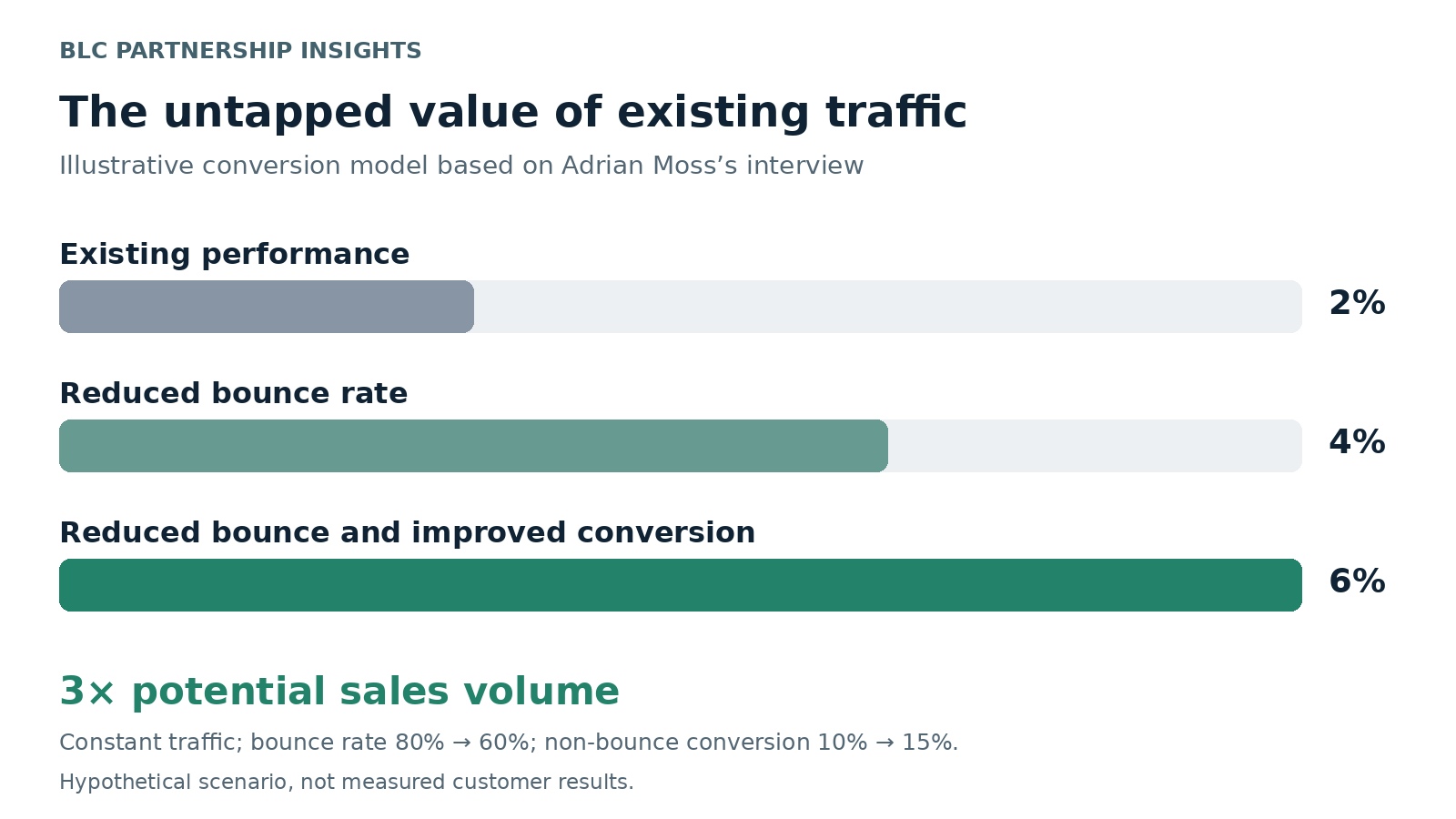
Consider an illustrative scenario in which a brand attracts 100,000 visits, experiences an 80% bounce rate and achieves a 2% overall conversion rate. Assuming conversions come from non-bouncing visits, that means 10% of those remaining visits convert.
What happens if the brand improves its ability to engage those visitors?
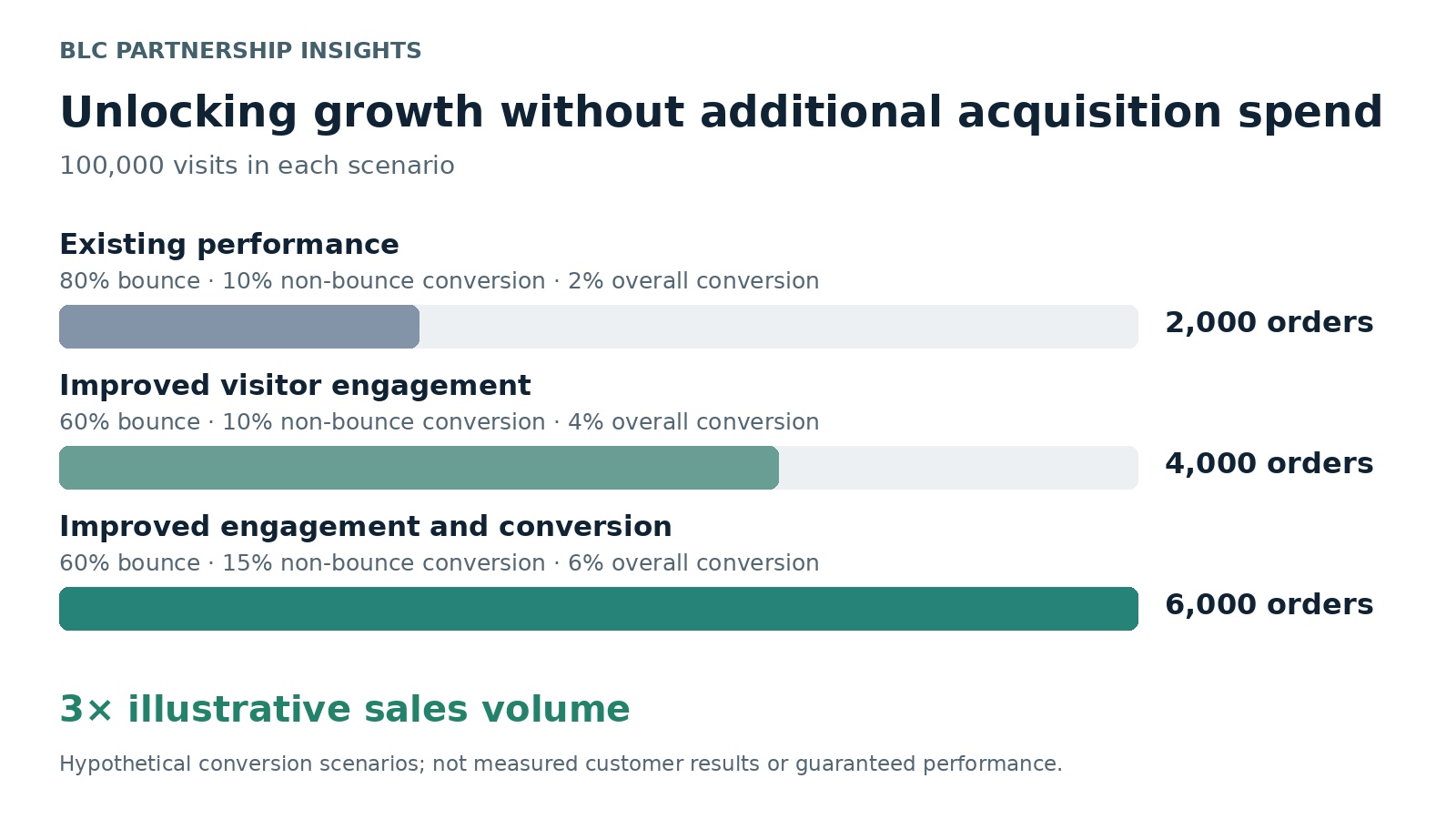
The implications extend beyond conversion optimisation. For marketing directors, chief financial officers and business leaders, the model illustrates why improving the effectiveness of existing acquisition investment deserves greater strategic attention.
It also raises questions about how budgets are allocated between attracting customers and improving the experiences they encounter.
Not every visitor intends to purchase, and not every bounce indicates a problem. Nevertheless, understanding which departures are caused by avoidable friction could unlock considerable value.
Identifying the Invisible Barriers to Growth
One of the challenges facing digital organisations is that conventional performance metrics do not necessarily explain why customers abandon their journeys.
A declining conversion rate might indicate a problem, but it does not automatically reveal its cause.
It could be a malfunctioning product comparison tool, a technical failure during checkout, an incomplete response from an API or an important piece of content missing from the mobile experience.
These are what Adrian describes as invisible blockers.
Quantum Metric's approach focuses on identifying such problems and quantifying their potential commercial impact, helping organisations prioritise improvements according to business value rather than technical severity alone.
This distinction is particularly important for enterprise organisations, where marketing, product and technology teams frequently compete for development resources.
A technical problem becomes a different conversation when the organisation understands how much revenue it could be losing because of it.
Is A/B Testing Telling Us the Whole Story?
Adrian also challenges conventional approaches to experimentation.
An A/B test may identify an overall winning variation of a landing page, but the aggregate result can conceal significant differences between customer segments.
First-time visitors may respond differently to returning customers. High-value customers may have different expectations from price-sensitive shoppers. Behaviour may also vary depending on the device, acquisition channel or time of visit.
As Adrian explains in his hypothetical example:
“Hard coding for version A misses the fact that version B is better for returning customers on a weekday.”
Adrian Moss, Quantum Metric
The implication is not that organisations should abandon A/B testing. Rather, they should develop a more nuanced understanding of the results and investigate whether different customer groups respond differently.
Such analysis requires statistical discipline to ensure that apparent differences between segments are genuine rather than the result of chance.
For organisations pursuing personalisation, this represents an important opportunity to move beyond designing experiences for the average customer towards understanding the diversity of their audiences.
Connecting Digital Intelligence with Enterprise Leadership
Perhaps the most strategically significant aspect of Adrian's perspective is his belief that digital analytics should extend well beyond the departments traditionally responsible for it.
“Data should be the heartbeat behind every single decision that is being made.”
Adrian Moss, Digital Evangelist, Quantum Metric
Marketing teams need to understand acquisition effectiveness. Product managers need to understand engagement. Technology teams need visibility into technical failures. Executive leadership needs to understand how these factors collectively influence business performance.
Yet when each department operates with different datasets, dashboards and performance objectives, developing a shared understanding of the customer becomes increasingly difficult.
Adrian describes Quantum Metric's approach through three principal areas of value.
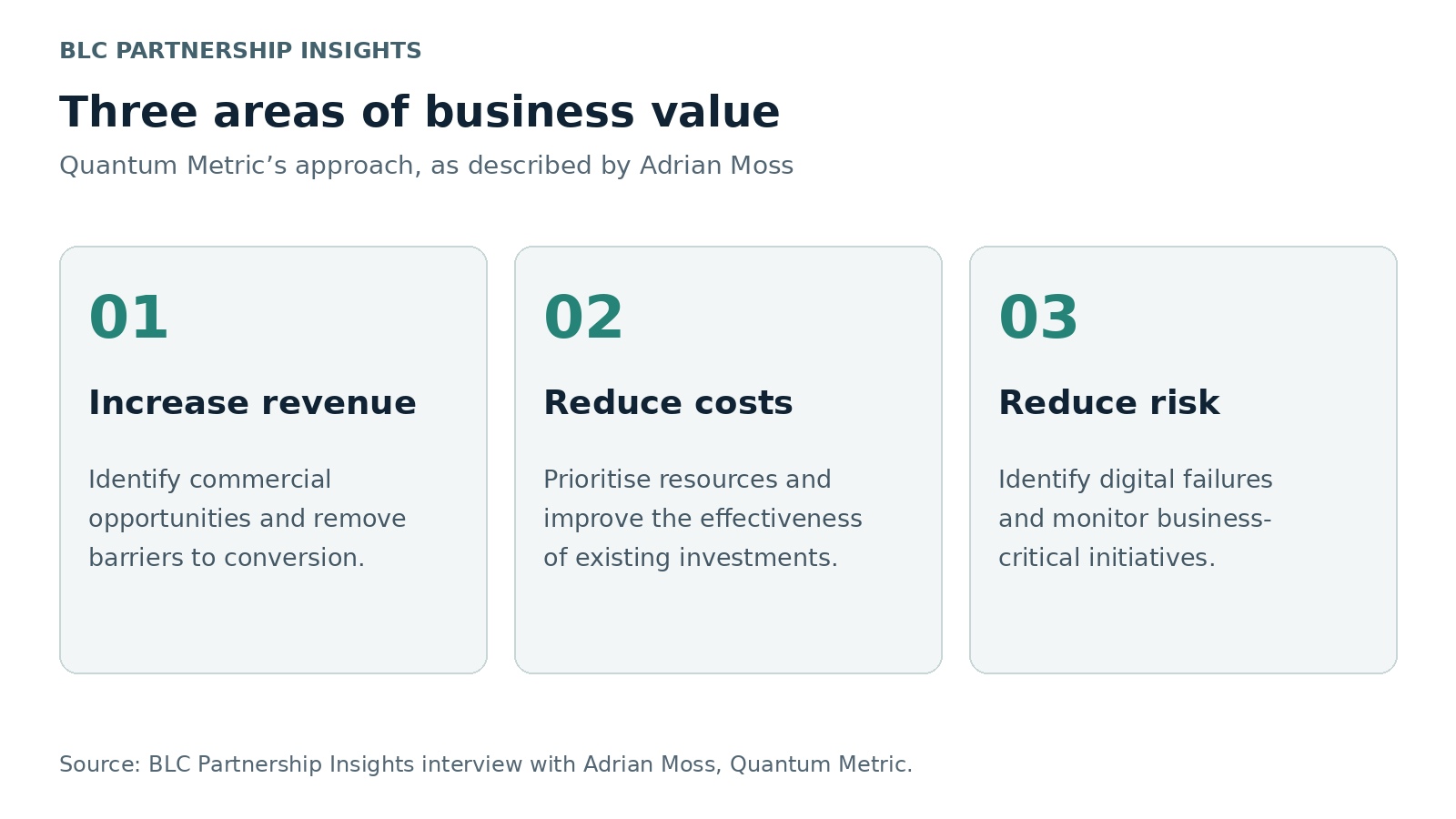
- Increase revenue: Identify commercial opportunities and remove barriers to conversion.
- Reduce costs: Prioritise resources and improve the effectiveness of existing investments.
- Reduce risk: Identify digital failures and monitor business-critical initiatives.
This positions digital experience intelligence not simply as a marketing or analytics capability, but as a potential component of enterprise decision-making infrastructure.
Introducing Quantum Metric: From Insights to Action
Quantum Metric operates in the digital experience analytics space, helping enterprise organisations understand customer behaviour and identify technical and experiential challenges.
Adrian explains that the company developed its capabilities working with complex organisations, including financial institutions and airlines, where technology, regulatory compliance and operational reliability are particularly important.
Its approach has subsequently expanded across marketing, experimentation, customer experience and executive leadership.
According to Adrian, the emergence of agentic AI creates further opportunities to help organisations interpret data, identify problems and access insights without relying exclusively on specialist analysts.
However, the real measure of success will not be the sophistication of the AI itself.
It will be whether organisations can make better decisions, respond more effectively to customer needs and deliver measurable business outcomes.
For BLC, this is a particularly relevant discussion as brands navigate an increasingly complex landscape of marketing technology, artificial intelligence and digital transformation.
Welcoming Adrian and Quantum Metric to the Brand Leadership Community
Quantum Metric's participation at MarTech & Web Analytics Wednesday marks the beginning of its event partnership with Brand Leadership Community.
Beyond introducing another technology provider to the community, the partnership creates an opportunity to explore important questions about the relationship between customer experience, technology investment and commercial performance.
Adrian's entrepreneurial background, combined with his experience across acquisition, experimentation and digital analytics, brings a valuable cross-disciplinary perspective to those discussions.
We look forward to welcoming Adrian and Quantum Metric to Copenhagen and continuing these conversations across the wider Brand Leadership Community.
Perhaps the most important question for brand leaders is not how much more technology they need, but how much untapped value remains within the customer experiences they already deliver.
Five Key Takeaways
Improving the experience of existing visitors could generate greater returns from current marketing investments.
Digital failures and poorly optimised experiences should be evaluated according to their business impact.
Understanding customer segments can reveal opportunities that aggregate conversion metrics and experimentation results overlook.
Marketing, product, technology and executive teams benefit from a shared understanding of customer experience and commercial performance.
Whether implementing analytics, personalisation or agentic AI, organisations should prioritise measurable improvements over technological sophistication alone.
Meet Adrian Moss in Copenhagen
Meet Adrian Moss, Digital Evangelist at Quantum Metric, at MarTech & Web Analytics Wednesday, where he joins a programme of industry practitioners exploring marketing technology, analytics, AI and digital customer experience.
MarTech & Web Analytics Wednesday Copenhagen
Join fellow brand leaders, marketers, analysts and technology professionals for an afternoon and evening of insights, peer-to-peer discussions and networking.
About Quantum Metric
Quantum Metric is an enterprise digital experience analytics technology provider focused on helping organisations understand customer behaviour, identify digital friction and connect customer experience with business performance.