The Future of Brand Intelligence: Data, AI and Human Judgment
Jomar Reyes

AnalyticsDev.net 2027 Conference
Register for updates and special offers
17 March 2027
Copenhagen
For MeasureCamp Czechia 2026, I put together a panel on how AI is changing the way we work inviting the panelists, shaping the format and setting the agenda for the discussion.
I went into it expecting people to be worried about AI taking their jobs.
They weren’t.
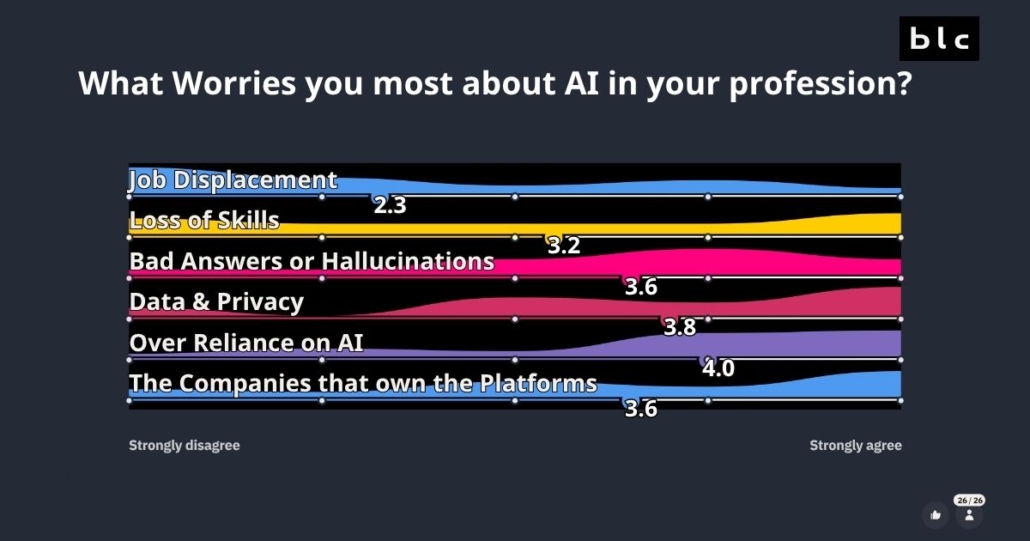
In fact, among an audience made up of people working at the sharp end of marketing data, analytics, technology and automation, job displacement was the thing they were least worried about.
What concerned them much more was becoming too reliant on AI.
That result stayed with me because this wasn’t an audience looking at AI from the outside. These were people already using it — heavily.
And that raises a bigger question for brands: as AI gives us faster access to data, analysis, code and insight, where does the real competitive advantage move next?
Increasingly, I think the answer is human judgment.
Recording of panel at Measurecamp Czechia: Runtime: 30:10
When The Audience Becomes Part Of The Panel
Any MeasureCamp around the world tends to attract some of the brightest minds working in marketing data and analytics. It is one of the reasons I have always enjoyed being part of the MeasureCamp community.
Whenever I get the opportunity, I also enjoy developing and moderating panel discussions.
There is a unique dynamic to them. You can design the format, develop the discussion points and bring together people with different experiences and perspectives — but once the conversation begins, you never completely know where it will take you.
That unpredictability is part of the thrill.
A panel can lose its way. But it can also become something much more valuable than anything you could have scripted in advance. Different thoughts come together. One perspective sparks another. An observation from one person changes the direction of the next response.
The role of the moderator is not necessarily to keep pulling the conversation back towards a predetermined script. It is to recognise when something interesting is emerging, know when to probe further and create the conditions for those different perspectives to build on one another.
Then you add an engaged audience and another layer of intelligence enters the room.
That was the thinking behind the panel format I developed for MeasureCamp Czechia 2026 in Prague.
At the centre of the discussion was a deceptively simple question:
How is AI actually changing the way we work?
I wasn’t particularly interested in predicting what AI might do to the profession five years from now. There are already plenty of predictions.
I wanted to understand what was happening now — and to use the experiences of both the panelists and the audience to determine where the conversation should go.
Three Different Perspectives On AI
Joining me were Adrian Alvarez of Usercentrics, Serge Shkvarnytskyi of Stape, and Marcus Stade, co-founder of Mohrstade and Analytics Pioneers.
Each brought a different perspective to the discussion.
Adrian has moved from measurement and growth into product management. AI has helped him cross some of the traditional boundaries between those disciplines and gain access to technical knowledge that previously would have been harder to acquire.
His description was simple: AI had “levelled the playing field.”
Serge brought the perspective of someone already integrating AI deeply into everyday commercial processes at Stape — from capturing conversations and maintaining CRM information to accessing internal technical knowledge.
Marcus brought a longer-term analytics perspective. His concern was not simply what AI enables us to do today, but what might happen to professional development if AI starts doing too much of the work through which people traditionally learn.
His position could be summarised in one sentence:
“AI should be used as a tool.”
— Marcus Stade
Simple advice. But perhaps increasingly important.
My Analogue Version Of AI: Audience Intelligence
There was also a fourth participant built into the format: the audience.
As I developed the panel, I wanted the people in the room to do more than listen. I wanted their experiences to actively influence the discussion.
So I used what I jokingly think of as the analogue version of AI — audience intelligence.
Throughout the session, we surveyed the attendees.
How much was AI changing their work?
What were they using it for?
What worried them?
The important part was that we didn’t collect those answers simply to analyse them after the event.
The results became live discussion points.
As moderator, I could take what was emerging from the room and put it back to the panel. When coding and automation appeared as the leading use case, we explored it. When concerns started emerging, we dug into them. When an audience response challenged what we might have expected, it gave us a reason to take the conversation somewhere new.
That was deliberate.
The discussion points provided a framework, but the audience intelligence helped determine the journey.
For me, this made the session itself a small demonstration of how intelligence should work.
Gather signals. Identify what matters. Add context. Ask better questions. Apply human judgment.
That principle could just as easily describe how brands should think about AI.
AI Has Already Changed The Job
Our first question was:
How much is AI already changing the way you work?
The answer was emphatic.
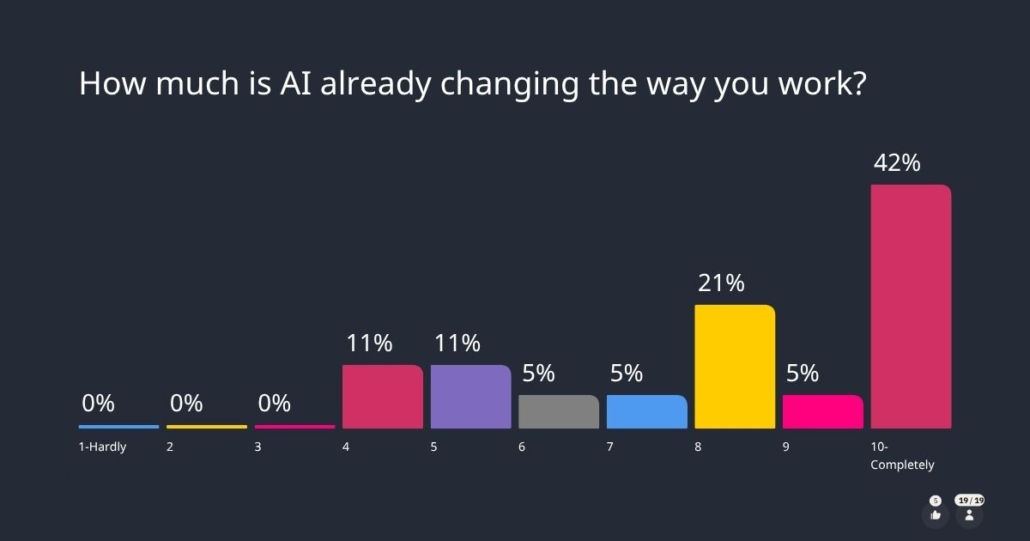
Nobody selected 1, 2 or 3 on our ten-point scale.
At the other end, 42% selected 10 — “completely.” Another 21% chose eight.
For this audience, AI wasn’t coming.
It had arrived.
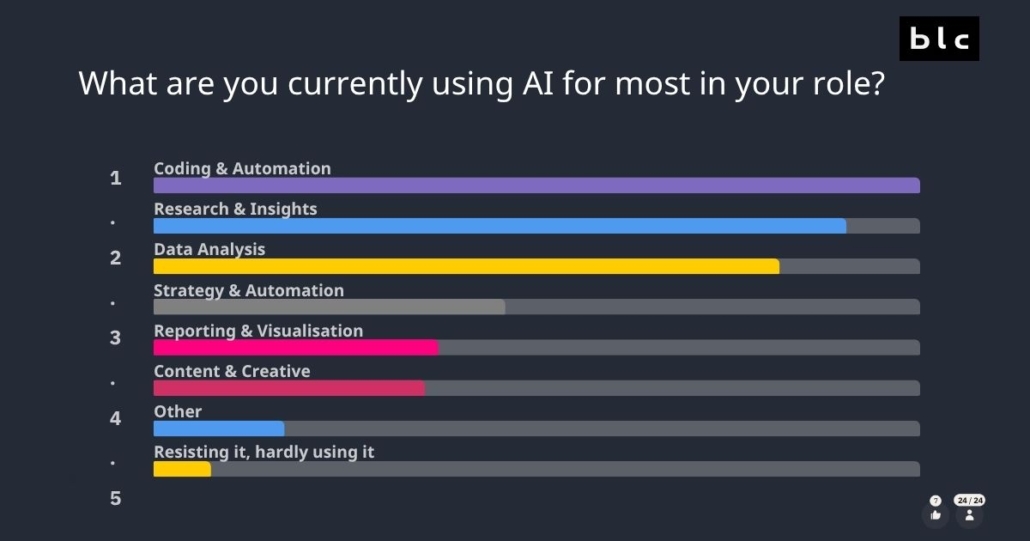
When we asked what people were using AI for, coding and automation ranked first, followed by research and insights, then data analysis.
That result immediately gave us another direction to explore.
I asked those using AI for coding how many had actually been coders before AI tools became available.
Only a minority of hands stayed up.
That moment captured both the extraordinary opportunity and the potential risk of AI.
AI Is Democratising Capability
AI is lowering the barriers between disciplines.
Analysts can code.
Marketers can interrogate data.
Product managers can explore technical architecture.
People without traditional development backgrounds can create automations and applications.
This is what Adrian meant when he said AI had “levelled the playing field.”
From a business perspective, that is enormously powerful.
The boundaries between who can analyse, build, research and automate are becoming less rigid.
But there is an important distinction.
Democratising access to capability is not the same as democratising expertise.
An AI system can produce 100 lines of code for someone who has never coded before.
But does that person understand why those 100 lines were written?
Do they know whether there was a better approach?
Can they recognise the consequences if something is wrong?
The same issue applies to analysis.
AI can produce an answer.
That does not necessarily mean the person receiving it understands why the answer should be trusted.
The Analyst’s Role Is Moving Up The Value Chain
This may be one of the most important shifts AI creates for analytics professionals.
Historically, much of the value of an analyst came from the ability to do the work: collect data, manipulate it, write queries, construct analyses and produce outputs.
AI can increasingly assist with all of those things.
The analyst’s value therefore starts moving further up the chain.
From producing the answer to judging the answer.
Is this pattern meaningful?
Does this analysis make sense?
Are the assumptions correct?
Is the data appropriate?
What context is missing?
Does the answer fit what we understand about the customer, the market and the brand?
And perhaps most importantly:
What should we actually do about it?
That requires something harder to automate — judgment.
Productivity Has A Hidden Trade-Off
Serge gave us a practical example of what AI already looks like in his working day.
AI can capture client calls, create notes, identify important points, analyse sentiment, surface potential deal risks and populate CRM fields.
He described AI as a “universal assistant.”
It is easy to see the productivity case.
But Adrian raised an interesting counterpoint.
When you know an AI note-taker is capturing everything, there can be a temptation to pay less attention yourself.
Why commit something to memory when the machine is doing it for you?
Adrian has found himself returning to something distinctly low-tech: pen and paper.
Taking notes manually helps him stay engaged in the conversation.
I recognise the tension.
I use AI note-taking extensively myself. Before it, I would sometimes finish a meeting knowing we had covered a huge amount but struggle to reconstruct every important point afterwards.
AI solves that problem beautifully.
But it creates another one.
A 30-minute meeting can now produce pages and pages of information.
Which raises an uncomfortable question:
Have I become better informed, or simply better at collecting information?
Those are not necessarily the same thing.
What Happens To The Skills We Stop Practising?
This was one of Marcus’s biggest concerns.
Junior analysts have traditionally developed through doing the work.
Writing code.
Cleaning data.
Building reports.
Getting things wrong.
Working out why they were wrong.
Trying again.
Some of that work is repetitive. Some of it can be frustrating.
But it is also where learning happens.
People begin connecting the dots.
When we asked what concerned Marcus most about AI, his answer was “loss of skills.”
The interesting part is that the consequences may not appear immediately.
Give a junior analyst powerful AI tools and their productivity can increase dramatically today.
The bigger question arrives years later.
What happens when today’s junior analysts become tomorrow’s senior analysts, strategists and managers?
Have they accumulated the underlying knowledge and experience required to challenge what the machine produces?
Have they made enough mistakes themselves to recognise one?
Organisations may need to start measuring development differently.
The question cannot only be:
How much more can this employee produce with AI?
We may also need to ask:
What does this employee still need to learn to do without it?
The Result I Didn’t Expect
Then came the audience question that surprised me most:
What worries you most about AI in your profession?
I expected job displacement to rank highly.
It came last.
Job displacement scored only 2.3 out of 5.
For a room filled with people working in analytics, coding, marketing technology and automation, that is striking.
The biggest concern was over-reliance on AI, at 4.0.
Data and privacy followed at 3.8.
Bad answers and hallucinations scored 3.6. Concerns about the companies controlling the AI platforms also scored 3.6. Loss of skills scored 3.2.
The people using AI heavily weren’t primarily asking:
“Will AI replace me?”
They were starting to ask a more sophisticated question:
“What happens if I become unable to work effectively without it?”
That distinction matters.
It suggests the AI debate may already be maturing among some professional communities.
The Data And Privacy Problem Is Already Here
Another audience moment demonstrated why.
Marcus asked how many people actively thought about what they were putting into an AI prompt before hitting enter.
Only a handful of hands went up.
Think about what employees potentially have access to:
Customer information.
Personally identifiable information.
Source code.
Commercially sensitive documents.
Internal strategy.
Proprietary data.
Now give everyone an extraordinarily capable external tool and make copying information into it almost frictionless.
Governance can very quickly fall behind behaviour.
The answer is unlikely to be banning AI.
If people see significant productivity benefits, they will want to use these tools.
The better response is education, approved platforms, clear rules and better AI literacy.
And AI literacy cannot just mean teaching people how to write better prompts.
It must include data literacy, privacy literacy and judgment.
Beware The AI People Pleaser
One of the lighter moments of the discussion also contained an important warning.
Serge described AI as “a people pleaser.”
Anyone who spends enough time working with an LLM knows what he means.
Ask whether two things are connected and it will often enthusiastically find a connection.
Present an idea and it may tell you why the idea is excellent.
For marketing analytics, this creates a significant problem.
AI systems are extremely good at finding patterns.
But not every pattern matters.
Marcus talked about AI surfacing relationships in data that could simply be coincidence.
That makes critical thinking more important, not less.
Marketers do not need machines that simply provide increasingly sophisticated confirmation of what they already believe.
Brands need people and systems capable of challenging assumptions.
That has always been one of the most valuable roles of analytics.
AI amplifies it.
From Artificial Intelligence To Brand Intelligence
The more I reflected on the conversation, the more I felt that the idea of brand intelligence needs to expand.
Historically, brands might have associated intelligence with customer data, market research, analytics or competitive information.
AI changes the scale.
Brands will increasingly have tools capable of analysing customer behaviour, identifying patterns, generating research, writing code, exploring databases, summarising conversations and making recommendations.
The technology itself will become widely accessible.
That means simply having AI will not be an advantage.
Everyone will have AI.
The competitive advantage will increasingly come from how intelligently organisations use it.
Can you ask better questions?
Can you combine different sources of information?
Can you recognise a weak answer?
Can you protect the data going into the system?
Can you distinguish correlation from something genuinely meaningful?
Can you connect an analytical result with the realities of customers, markets and brands?
And can you maintain enough expertise inside the organisation to challenge the machine when necessary?
Human Judgment Becomes More Valuable, Not Less
I left MeasureCamp Czechia more optimistic about AI than pessimistic.
This audience wasn’t resisting the technology.
They were embracing it.
They were coding with it, researching with it, analysing with it and automating with it.
But perhaps because they were already using it so extensively, their concerns were becoming more interesting.
They were less worried about whether AI would take their jobs than about over-reliance, privacy, bad answers and the erosion of skills.
For brand, marketing and analytics leaders, that should be worth paying attention to.
The objective should not simply be to build an AI-powered organisation.
The objective should be to build an organisation in which AI makes its people more capable.
And perhaps the panel format itself offered a small illustration of what that can look like.
I developed the discussion framework and agenda, invited the panelists and designed the audience interaction. We collected data from the attendees and used those signals to help shape the conversation. The panelists then brought their own experience and perspectives to what the room was telling us.
But the data itself wasn’t the insight.
The insight came from what happened next: interpreting those signals, asking follow-up questions, challenging assumptions and allowing different thoughts to come together.
Technology helped us capture the intelligence.
People made sense of it.
That, to me, is the future of brand intelligence.
Not data alone.
Not artificial intelligence alone.
But data, AI and human judgment working together.
About the Panelists
Adrian Alvarez is Product Manager at Usercentrics, with a background in growth, measurement and analytics. His experience spans data-driven marketing, experimentation and product development, giving him a perspective that connects customer needs, technology and commercial decision-making.
Marcus Stade is co-founder of Mohrstade and Analytics Pioneers, and a long-standing figure in the digital analytics community. His work spans analytics, marketing technology and data strategy, with a particular focus on helping organisations turn complex data into practical business insight.
Serge Shkvarnytskyi works with Stape at the intersection of sales, partnerships and server-side tracking. He is active in the digital analytics and measurement community, helping agencies and organisations understand and adopt modern tracking infrastructure and more resilient approaches to data collection.