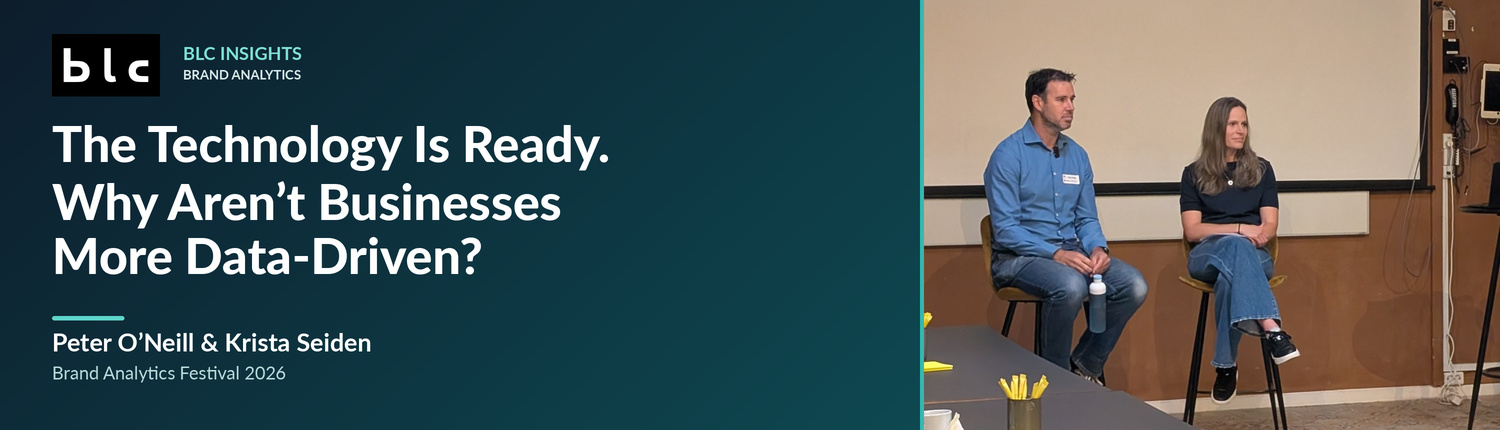
The Technology Is Ready. Why Aren’t Businesses More Data-Driven?
With increasingly sophisticated analytics platforms, AI-powered insights and more customer data than ever before, why do organisations still struggle to make data-driven decisions? At Brand Analytics Festival 2026, Krista Seiden interviewed Peter O’Neill in a fireside chat about what a global retailer’s analytics transformation reveals about the barriers that technology alone cannot overcome.

At a time when artificial intelligence promises to make analytics more accessible than ever, an uncomfortable question remains: if organisations have the technology, the data and the expertise, why are so many still struggling to turn information into better business decisions? It was a question that emerged during a fireside chat in which Krista interviewed Peter at Amplitude’s Wizard Bar, part of Brand Analytics Festival 2026, organised by Brand Leadership Community.
Krista, a recognised analytics expert at Amplitude, interviewed Peter, founder of MeasureCamp — established in 2012 and now hosting digital analytics unconferences in more than 30 cities worldwide each year — a provider of Fractional Digital Analytics Leadership services, and a former digital analytics director at a major international retailer, to examine the challenges of transforming analytics across a global organisation. What began as Krista’s interview about migrating from Google Analytics to Amplitude evolved into something more fundamental: an examination of organisational change, trust, decision-making and the persistent gap between having access to data and knowing how to use it.
The fireside chat offered an important reminder for business leaders: becoming data-driven is not primarily a technology project. It is an organisational transformation.
A Global Analytics Transformation Under Pressure
When Peter joined the retailer in July 2023, his ambition was to help move the organisation from relatively low digital analytics maturity towards a much more advanced, data-driven operating model. Having spent approximately two decades working in digital analytics, including running his own consultancy, Peter wanted to demonstrate that the principles he had recommended to clients could deliver results inside a large organisation.
He quickly discovered that the company was still using Universal Analytics 360, which was approaching its shutdown in June 2024. The organisation had already begun transitioning towards Google Analytics 4, but Peter questioned whether moving automatically to Google’s replacement platform was the right strategic decision. Rather than treating the migration as a routine technology upgrade, he saw an opportunity to reconsider what the organisation actually needed from analytics.
The evaluation involved stakeholders from marketing, product, analytics and different countries. Ultimately, the retailer selected Amplitude. For Peter, the attraction was not simply that Amplitude could replace existing reporting capabilities. It offered the potential for people across the business to explore customer behaviour in a more intuitive way.
However, the decision introduced an extraordinary implementation challenge. With the contract signed in late February, the team had approximately four months to migrate critical analytics capabilities across an e-commerce operation spanning more than 50 countries. This involved multiple technology platforms, websites and applications, each with differing requirements. There was little time for the extensive planning, parallel measurement and gradual organisational transition normally associated with a migration of this scale.
The experience exposed a crucial distinction: deploying new technology is one challenge; ensuring an organisation can effectively use it is another.
Governance Before Perfection
Faced with an exceptionally compressed timeline, Peter made a decision that would challenge conventional approaches to large-scale technology implementation. Rather than establish a lengthy consensus-building process around every implementation detail, he defined the foundational data structures and naming conventions himself. These included how analytics properties would be organised, how events would be named and how the same standards would be applied across countries.
His reasoning was pragmatic. The organisation needed a consistent starting point more urgently than it needed a theoretically perfect model. The team then prioritised the essential e-commerce tracking requirements, beginning with ten critical events, followed by subsequent implementation phases. This allowed the migration to focus on business-critical functionality rather than attempting to recreate every existing measurement capability immediately.
The lesson extends well beyond analytics technology. Organisations frequently invest significant resources in sophisticated tools without first establishing the standards, responsibilities and operating principles required to use them consistently. Data governance is not simply about keeping information organised. It creates the conditions for trust, comparability and confident decision-making.
Yet governance alone could not resolve the challenges that emerged when familiar reporting tools disappeared.
The Hardest Migration Was Human
Technology transformations are often assessed through implementation milestones: systems deployed, events tracked, data collected and dashboards created. But the effectiveness of an analytics platform ultimately depends on the people expected to use it.
Across the retailer, teams accustomed to Google Analytics suddenly had to adopt new interfaces, new reporting methods and, in some cases, different interpretations of familiar performance metrics. Resistance was inevitable. Marketing teams were particularly concerned about losing access to reports they had relied upon for years.
Differences in attribution methodologies also changed how marketing performance appeared. Traffic previously credited to campaigns could be classified differently under the new measurement approach. This created an uncomfortable situation: reports could look worse even when the underlying business had not deteriorated.
Peter described the difficulties of persuading teams to accept new interpretations of their performance. The response required extensive communication, transparency, training and practical solutions to individual teams’ reporting needs.
It also revealed a wider organisational challenge. People do not evaluate data entirely independently of their existing assumptions, responsibilities or performance expectations. When new information challenges established interpretations of success, resistance can become a management and cultural issue rather than a technical one.
For analytics transformation to succeed, organisations must help employees understand not only how new tools work, but why established assumptions may need to change.
Are Businesses Using Data to Make Decisions — or Justify Them?
Perhaps the most revealing moment of the Wizard Bar fireside chat came during the audience questions. Asked about the most common expensive decision-making mistakes organisations make despite having sophisticated analytics capabilities, Peter identified a familiar problem:
“Using data to justify a decision after the fact rather than to make the decision in the first place.”
— Peter, Brand Analytics Festival 2026
It is a deceptively simple observation with far-reaching implications. In principle, analytics should help organisations challenge assumptions, identify opportunities and make more informed decisions. In practice, businesses can sometimes approach data with a preferred conclusion already in mind. Dashboards and reports then become instruments for validating decisions rather than questioning them.
This raises a fundamental issue for senior leadership. Investment in analytics does not automatically create a culture of evidence-based decision-making. Nor does increasing the volume of available information guarantee better judgement.
A genuinely data-driven organisation must be willing to act on evidence that contradicts expectations. That requires curiosity, psychological safety, accountability and leadership willing to question its own assumptions.
The value of analytics is not measured by how convincingly it supports an existing strategy, but by how effectively it helps organisations improve that strategy.
AI Is Making Answers Easier. But Are We Asking Better Questions?
The discussion became particularly relevant when Krista described how AI-powered analytics could reduce the friction between business users and the information they need. Rather than requiring executives, marketers or sales teams to navigate unfamiliar analytics dashboards, AI assistants and integrations can increasingly deliver answers inside the collaboration tools employees already use. A commercial leader might ask a question directly through a workplace messaging platform and receive an analytical response without opening a separate interface. For Krista, this accessibility represents an important step towards making analytics genuinely useful across an organisation.
The opportunity is significant. For years, analytics teams have struggled to make data accessible to colleagues who lack specialist technical knowledge. AI has the potential to reduce that dependency and support greater self-service.
But Peter challenged the assumption that easier access to answers necessarily addresses the underlying problem. His response captured the central tension:
“If the question's wrong in the first place, we've got all the answers. Do we have the right questions?”
— Peter, Brand Analytics Festival 2026
This distinction deserves particular attention. AI may dramatically accelerate how organisations retrieve and interpret information. It does not automatically ensure that business teams understand which questions matter. Nor does it remove the need to understand customer motivations, commercial context or the consequences of particular decisions.
An organisation can produce thousands of sophisticated analytical answers and still fail to understand what its customers actually need. The next competitive advantage in analytics may therefore depend less on generating answers and more on developing the ability to ask better questions.
From Data Intelligence to Audience Intelligence
This is where analytics transformation becomes increasingly relevant to brand leadership, marketing and customer experience. The objective should not simply be to create organisations with more dashboards, more reports or faster access to information. It should be to develop organisations that understand their audiences more deeply and use that understanding to create value.
Brand Leadership Community’s concept of Audience Intelligence offers a useful perspective on this challenge. Where artificial intelligence can help organisations process information at scale, Audience Intelligence emphasises the human understanding required to interpret behaviour, recognise motivations and connect customer needs with business decisions. The two approaches are complementary rather than competing.
Technology can reveal patterns in customer journeys, purchasing behaviour and product engagement. Human insight helps organisations understand why those patterns matter. This requires closer collaboration between analytics, marketing, product, customer experience and commercial leadership. Rather than treating analytics as a specialist reporting function, organisations need to make customer understanding a shared responsibility.
The experience at the retailer reinforces this point. One of Peter’s most rewarding observations was that employees outside the analytics function began developing the confidence to use the platform and teach others. The value was not restricted to the implementation team or the technology itself. It emerged when people across the organisation began building new capabilities and sharing knowledge.
That is arguably a more meaningful indicator of transformation than the number of dashboards successfully migrated.
The Future of Analytics Is Organisational, Not Just Technological
There is little doubt that analytics technology will continue to advance. AI assistants, automated insights, improved data governance and increasingly connected technology platforms promise to make sophisticated analytical capabilities available to a much wider audience. Yet Krista’s interview with Peter illustrates why these developments, while important, are unlikely to solve every challenge businesses face.
Organisations still need clear measurement principles, reliable data, relevant skills and the confidence to question established assumptions. They need leaders who encourage evidence-led decision-making rather than simply expecting analytics to validate existing strategies. And they need to remember that behind every data point is a person whose needs, motivations and behaviour may not be fully explained by a dashboard.
The retailer’s experience illustrates both the complexity and potential rewards of this transformation. A technology migration that began under severe time pressure became an opportunity to rethink how analytics could support people across a global business.
For the wider business community, the central lesson is clear. The next chapter of analytics will not be defined solely by how intelligent our technology becomes, but by how intelligently organisations use it.
And perhaps the most important question is no longer whether businesses have enough data. It is whether they have developed the curiosity, capabilities and culture to turn that data into genuine customer understanding.
Five Key Takeaways
Implementing sophisticated technology delivers limited value unless people, processes and decision-making practices evolve alongside it.
Consistent data standards, clear ownership and prioritised implementation enable organisations to build reliable, scalable analytics capabilities.
Changes in attribution and reporting can create resistance when new interpretations contradict familiar performance indicators.
Accelerating access to information does not replace critical thinking, customer understanding or sound commercial judgement.
The greatest opportunity lies in combining technological capabilities with deeper insights into customer motivations, behaviour and needs.