The Human Future of Analytics: Judgement, Trust and the AI Revolution

AnalyticsDev.net 2027 Conference
Register for updates and special offers
17 March 2027
Copenhagen
Across three European MeasureCamp events in Prague, London and Stockholm, BLC’s surveys identify recurring attitudes towards AI in geographically distinct analytics communities. These gatherings can draw international participants; the findings reflect a European event sample, not verified national or cultural groups. Conversations with analytics leaders in London and Stockholm explore what the shared concerns mean for human judgement, skills and trust.
BRAND LEADERSHIP COMMUNITY / EUROPEAN RESEARCH REPORT
Section: Brand Analytics | Research: MeasureCamp Prague, London and Stockholm, September–November 2026
Across three European cities, the same question was put to analytics professionals: how much is artificial intelligence changing the way you work? The answers suggest a profession already experiencing profound change. Yet the strongest shared concern was not that AI would take people’s jobs. It was that professionals might become too dependent on it.
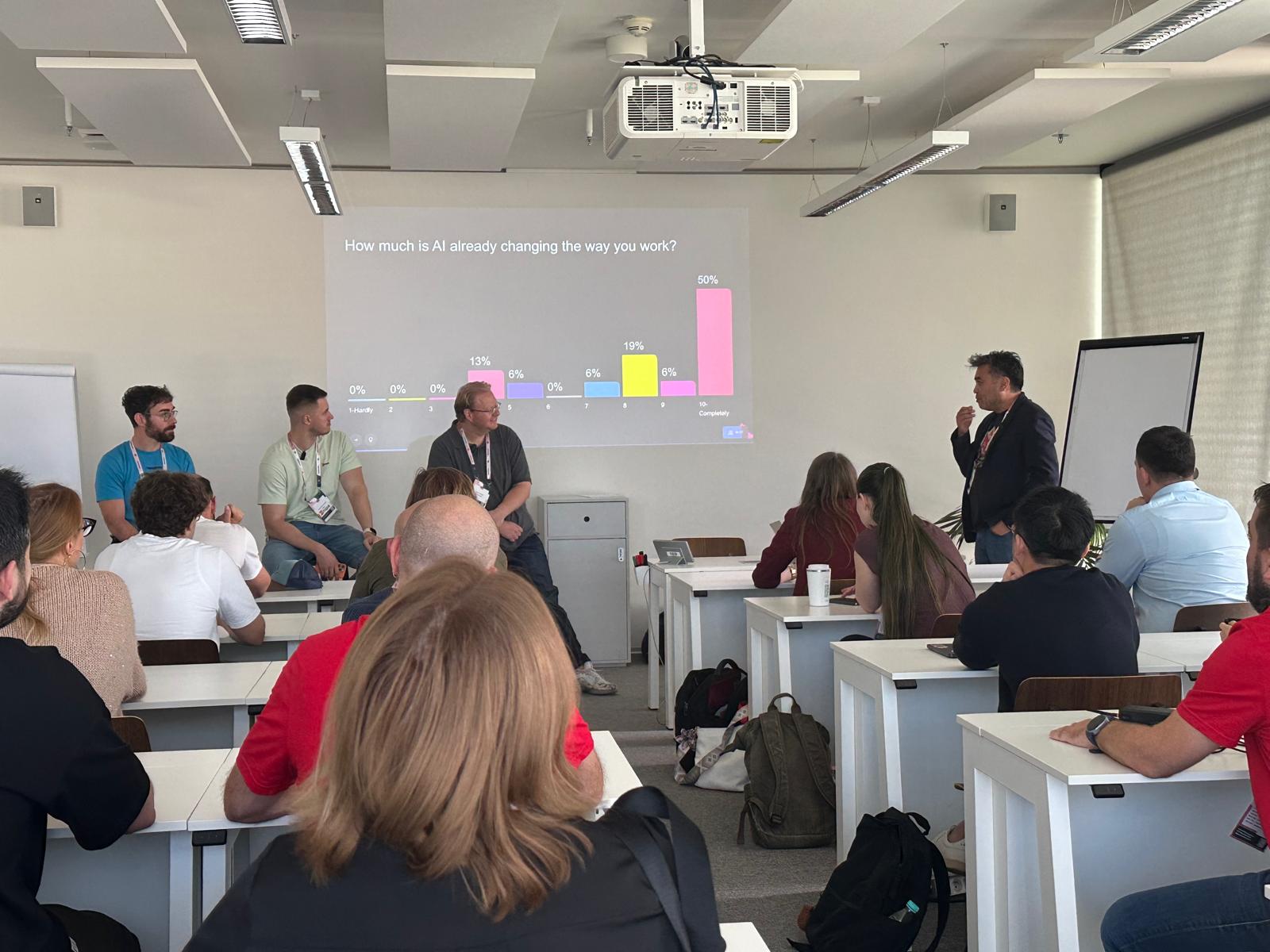
At MeasureCamp Prague on 12 September, London on 26 September and Stockholm on 7 November 2026, Brand Leadership Community gathered live audience responses about AI’s impact, leading applications and professional risks. The three events generated 72 survey submissions in total, although individual questions received fewer answers. The research spans three distinct European cities, and MeasureCamp gatherings can attract a highly international mix: organisers have observed up to 25 nationalities at MeasureCamp Copenhagen. Respondents’ nationalities were not collected for these three surveys, so that Copenhagen experience should be understood as context rather than a demographic finding from Prague, London or Stockholm.
These are small, self-selected samples, not a representative study of European analytics professionals, and city differences cannot establish cultural effects or a trend over time. What makes them interesting is that, across three separate European event communities, some attitudes nevertheless recur—most notably concern about over-reliance on AI. Paired with discussions moderated by BLC founder Jomar Reyes in London and Stockholm, that consistency reveals a productive tension: technology is accelerating what analysts can produce while renewing the importance of what people must still understand, challenge and decide.
Across three European cities, the same question was put to analytics professionals: how much is artificial intelligence changing the way you work? The answers suggest a profession already experiencing profound change. Yet the strongest shared concern was not that AI would take people’s jobs. It was that professionals might become too dependent on it.
At MeasureCamp Prague on 12 September, London on 26 September and Stockholm on 7 November 2026, Brand Leadership Community gathered live audience responses about AI’s impact, leading applications and professional risks. The three events generated 72 survey submissions in total, although individual questions received fewer answers. The research spans three distinct European cities, and MeasureCamp gatherings can attract a highly international mix: organisers have observed up to 25 nationalities at MeasureCamp Copenhagen. Respondents’ nationalities were not collected for these three surveys, so that Copenhagen experience should be understood as context rather than a demographic finding from Prague, London or Stockholm.
These are small, self-selected samples, not a representative study of European analytics professionals, and city differences cannot establish cultural effects or a trend over time. What makes them interesting is that, across three separate European event communities, some attitudes nevertheless recur—most notably concern about over-reliance on AI. Paired with discussions moderated by BLC founder Jomar Reyes in London and Stockholm, that consistency reveals a productive tension: technology is accelerating what analysts can produce while renewing the importance of what people must still understand, challenge and decide.
Three Cities, Different Experiences of the AI Revolution
The strongest reported change came in Prague, where respondents scored AI’s impact on their working lives at an average of 8.00 out of ten. London averaged 7.21 and Stockholm 6.94. Those differences describe three separate audiences, not a chronological decline in adoption. Across all 56 responses to this question, 57% gave AI an impact score of eight or higher.
The unevenness was also visible in the discussions. At MeasureCamp Stockholm, Luiza de Lange, an organiser and experimentation professional at If Insurance, described the distance between fast-moving agencies and established businesses navigating approved technologies, governance and integration constraints.
“there’s quite a disparity happening right now between how fast and how much the agencies are doing” — Luiza de Lange, edited-video estimate 07:08
A London perspective complicated the picture in a useful way. Marie Fenner, Senior Vice President of Analytics at Piano, described clients at very different stages of adoption, while Jon Su of PostHog discussed how AI-assisted instrumentation could compress previously lengthy technical implementations. These examples reflect different kinds of organisational readiness rather than a single European trajectory.
For leaders, the central question is therefore not which city is ‘ahead’. It is whether teams have the data foundations, freedom to experiment, safeguards and expertise necessary to turn AI’s possibilities into dependable business results.
From AI Adoption to Better Decisions
The three surveys also asked what practitioners use AI for. Among 60 people who ranked applications, coding and automation received the most first-place votes (38.3%, 23 respondents), ahead of data analysis (21.7%, 13 respondents) and research and insights (16.7%, 10 respondents). This suggests a shift from trying conversational tools towards embedding AI in practical work, though applications varied by respondent.
The impact figures and these use-case rankings tell only part of the story. Faster instrumentation, automated workflows and natural-language queries can make information easier to obtain; they do not automatically establish which questions are worth asking or whether the answers are right.
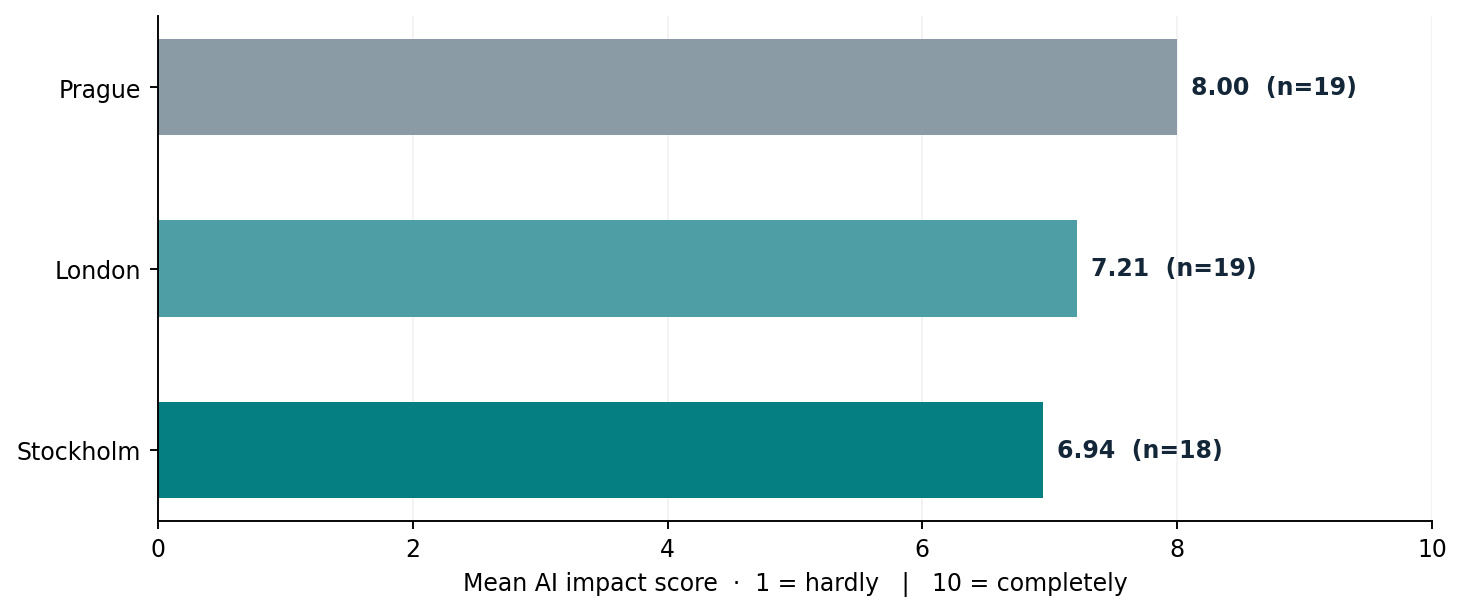
FIGURE 1 · Perceived impact of AI on working life, by city. Mean scores from the 1–10 question; Prague n=19, London n=19, Stockholm n=18.
Prague’s higher mean impact score, London’s intermediate result and Stockholm’s lower result should be read as descriptive contrasts between small event samples. They are most useful as a starting point for asking what helps professionals make effective and responsible use of AI.
Coding and automation led first-ranked applications at 38.3%, followed by data analysis (21.7%) and research and insights (16.7%). The different categories also hint at a changing division of labour: machines can increasingly carry out steps that once consumed analysts’ time, leaving practitioners to interpret what the outputs mean.
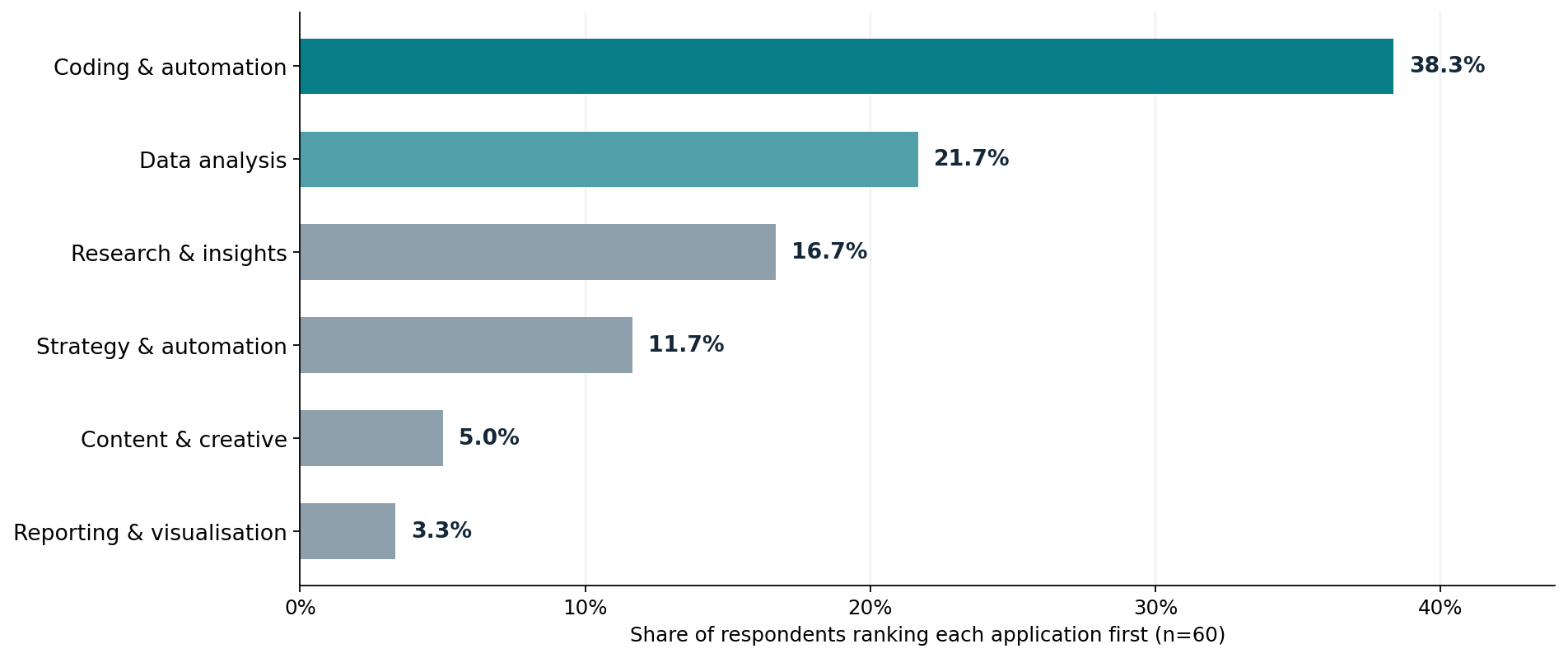
FIGURE 2 · Share of respondents ranking each AI application first across Prague, London and Stockholm (n=60). Percentages use all 60 responses as the denominator. “Other” and “Resisting it” each received 1.7% and are omitted from the chart for readability.
That distinction surfaced in both panel discussions. In Stockholm, an anonymous audience contributor noted that despite years of changing analytics platforms, businesses still ask familiar questions about metric movements, anomalies and what to do next.
As the attendee observed, the “core questions still the same” (Stockholm edited-video estimate 13:10). The technology may change the route to an answer; deciding whether the answer matters still requires context and judgement.
In London, Piano’s Marie Fenner described AI as a companion across tagging, quality assurance and analysis. She put the analyst’s enduring role succinctly: “we are the data storyteller” (London recording, 10:15). Humans still need to interpret evidence and recommend action.
Snowplow’s Jordan Peck offered an equally direct challenge: “The goal isn’t to make dashboards faster.” (London recording, 19:48). In his view, the opportunity lies in moving beyond routine reporting towards trustworthy insights that can genuinely affect decisions. The three-city research makes that distinction more urgent, not less.
Faster Output, Greater Pressure
The acceleration described in London and Stockholm brings a second dilemma. AI can make complex work dramatically faster, but increased capability often creates increased expectations. In Stockholm, Stape’s Serge Shkvarnytskyi questioned whether teams have enough time to evaluate the growing volume of AI-assisted output.
He spoke about “the expectation towards your productivity” (Stockholm edited-video estimate 21:18). Speed can become a new workplace baseline rather than time returned to practitioners for reflection.
When a lengthy AI-assisted document arrived, Serge recalled wondering, “did you even read it?” (Stockholm edited-video estimate 22:00). An anonymous audience member raised a related problem: cognitive overload as tools make it possible to pursue more activities without necessarily improving understanding.
These observations add an essential human dimension to the survey findings. A technology that removes repetitive labour can also multiply the work people are expected to review, defend and act upon.
The London panel explored a possible response. Jordan Peck described using AI to brainstorm implementation choices while being careful to “not outsource the thinking” (London recording, 18:15). The point is not to reject automation, but to decide deliberately which parts of professional work deserve human attention.
The Shared Anxiety: Dependence, Not Displacement
The most consistent result across Prague, London and Stockholm concerned the risks of AI. Participants rated six concerns on a five-point scale, with response counts varying by item.
Over-reliance on AI emerged as the highest-rated concern in all three cities, with a pooled mean of 3.94 out of five. Data and privacy followed at 3.73, platform ownership at 3.64, and inaccurate AI-generated answers at 3.63. Job displacement received the lowest combined score at 2.72.
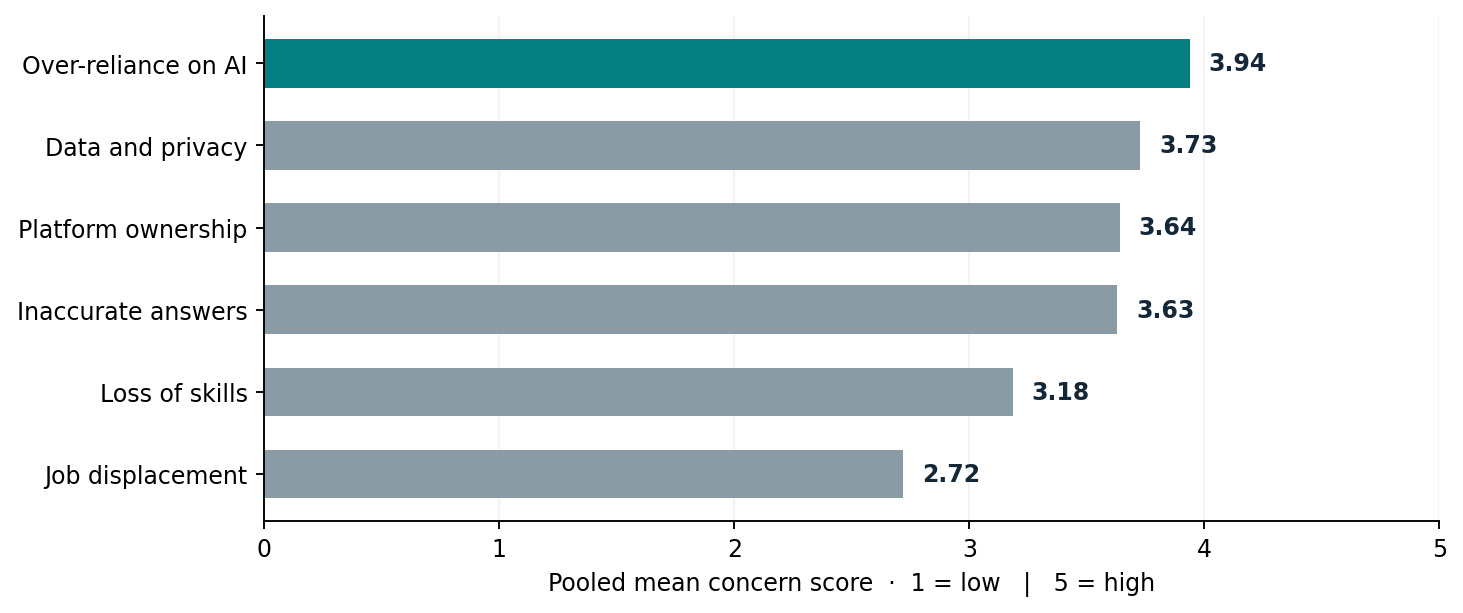
FIGURE 3 · Pooled respondent-weighted concern ratings. Each topic has 64–66 ratings across the three events; the denominator varies because some participants skipped individual questions.
The overall pattern concealed meaningful differences. London respondents rated job displacement more highly than those in Prague or Stockholm. Stockholm respondents expressed especially strong concern about who owns and controls AI platforms. These are signals for further enquiry, not conclusions about national attitudes.
Across all three audiences, however, over-reliance ranked highest, producing a pooled mean of 3.94 out of five. Job displacement ranked lowest overall, at 2.72. The emerging question is less whether AI will replace the analytics profession than whether professionals will retain enough independence to question systems on which they increasingly rely.
That concern resonated with Luiza de Lange’s call, during the Stockholm panel, for scrutiny of ambitious AI vendor promises:
“Ask the hard questions, be the resistance in a way to make sure that you actually understand what you’re getting.” — Luiza de Lange, edited-video estimate 19:00
The London discussion sharpened the same point from another angle. Technical speed can outpace human comprehension, making reliability and accountability harder rather than easier to guarantee.
PostHog’s Jon Su argued for stronger deterministic safeguards around AI-assisted systems and singled out “judgment and taste” (London recording, 28:25) as enduring human contributions. Across the panels, critical evaluation emerged as a professional capability to be protected, not a friction to be automated away.
Who Develops the Next Generation of Analysts?
The three-city data also raised a longer-term question: what happens to professional expertise when AI eliminates many tasks through which analysts historically learned? Loss of skills scored 3.18 out of five across the combined responses, above job displacement but below concerns about dependence, privacy and reliability.
In Stockholm, Luiza warned that newcomers “may potentially not learn how to do things manually” (edited-video estimate 25:29). Her concern was not that repetitive work is inherently valuable, but that understanding how processes work helps analysts identify mistakes and challenge assumptions.
London’s discussion provided a complementary perspective. Marie Fenner recalled how learning to build a data connection manually helped her understand and appreciate later automation. A shortcut can save time; an understanding of the journey can make the shortcut safer and more useful.
For employers, the implication is practical: redesign mentoring, apprenticeship and review so that junior practitioners develop data literacy and sound judgement even when AI handles much of the execution. The next generation need not recreate every old process, but should be able to interrogate what automated systems produce.
Trust Remains the Human Advantage
Beyond the mechanics of analysis lies the relationship between organisations and the people they serve. In Stockholm, Conductrics’ Blair Ault cautioned that poorly judged AI use can undermine customer confidence. That risk sits alongside survey concerns about data privacy, platform ownership and inaccurate answers.
The panels also returned to the value of professional community. Stape’s Serge Shkvarnytskyi described industry gatherings as opportunities to understand customers and colleagues rather than simply to pursue conventional sales relationships.
“I don’t think that’s something that AI can replace ever.” — Serge Shkvarnytskyi, edited-video estimate 02:05
Blair expressed a similar philosophy:
“I’m not trying to market to you, I’m just trying to get to know you.” — Blair Ault, edited-video estimate 05:04
Prague, London and Stockholm provide a European cross-city perspective, potentially shaped by internationally mixed audiences, rather than a definitive forecast for individual countries or cultures. The recurring concern about dependence nonetheless deserves attention. It raises a coherent set of questions for leaders: how to gain the benefits of automation without eroding expertise, how to ensure trustworthy data and decisions, and how to preserve meaningful human relationships.
The three surveys identify the tension; the two panel discussions help explain it. AI can generate more information and compress work that once required weeks, but judgement, learning and trust remain central to what turns outputs into business value.
The future of analytics may be artificial in its intelligence, but its success will remain profoundly human.
Five Key Takeaways
AI is already reshaping work across three specialist communities. Of 56 impact responses, 57% rated AI’s influence eight or higher out of ten; Prague reported the highest average, but the city samples cannot establish a time trend.
Dependence mattered more than displacement in the combined responses. Over-reliance ranked as the leading concern in all three cities, while job displacement was lowest overall; London showed a relatively higher level of job concern.
Speed is not the same as insight. Coding and automation led primary uses, while London and Stockholm speakers stressed the importance of interpretation, business context and human judgement.
Professional skills need deliberate development. As AI absorbs manual work, mentoring, validation and critical thinking must remain part of analysts’ training.
Trust, governance and community are strategic assets. The surveys highlighted privacy, reliability and platform control; the panels connected these concerns to accountable decisions and authentic relationships.
Sources: ‘AI and Your Work’ audience surveys conducted at MeasureCamp Prague (12 September 2026), London (26 September 2026) and Stockholm (7 November 2026), together with transcriptions of recordings from the live panel discussions in London and Stockholm. Survey samples were self-selected and response counts vary by question; findings are descriptive rather than representative.
AI Usage Disclosure
This report was developed by Brand Leadership Community with the assistance of artificial intelligence to support research, survey data analysis, identification of key themes, report writing and the creation of supporting charts.
The findings are based on original surveys conducted at MeasureCamp Prague, London and Stockholm, alongside recorded panel discussions.
All content has been reviewed and validated by the BLC editorial team for quality, factual accuracy and editorial integrity. AI was used to support the process, while human judgement, oversight and editorial responsibility remained central throughout.